|
 Lajos Ludwig Porges (b. 04/03/1839, d. 01/01/1894) buried Vienna Zentralfriedhof 1. Tor, 5b-14-25, Lajos Ludwig Porges (b. 04/03/1839, d. 01/01/1894) buried Vienna Zentralfriedhof 1. Tor, 5b-14-25,
married Viktoria Bing-Eisenstädter de Buzias (b. 1850)
Theodor Porges
Ella Porges
Edmund Ödön Porges (b. Vienna 25/05/1872, d. Vienna 01/03/1917 at Sanatorium Loew, Mariannengasse 20; buried Zentralfriedhof 1. Tor, Israelitische Abteilung, 53b-29-1)
divorced Hedwig Klebinder (b. Vienna 11/03/1877, d. ?)
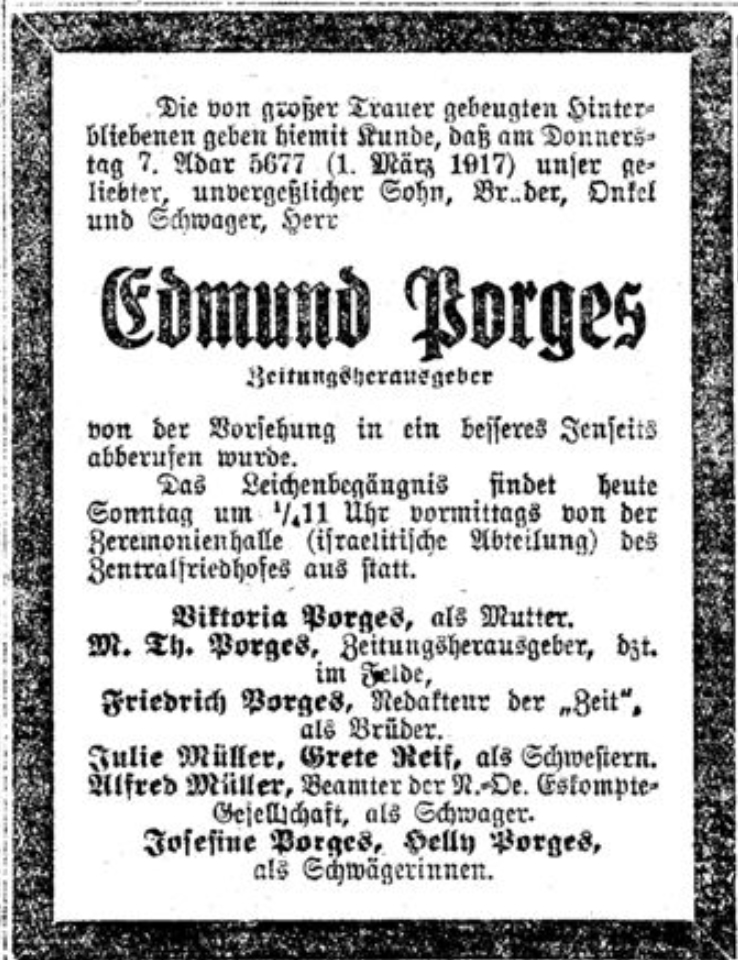 |
English translation of the obituary (Vienna newspaper, 4 March 1917):
The bereaved family, bowed by great sorrow, hereby give notice that on Thursday, 7 Adar 5677 (1 March 1917), our beloved, unforgettable son, brother, uncle and brother-in-law, Mr.
EDMUND PORGES
Newspaper Publisher
was called by Providence into a better hereafter.
The funeral takes place today, Sunday, at a quarter past ten in the morning, from the Ceremonial Hall (Israelite section) of the Central Cemetery.
Viktoria Porges, as mother.
M. Th. Porges, newspaper publisher, presently on military service,
Friedrich Porges, editor of Die Zeit, as brothers.
Julie Müller, Grete Reif, as sisters.
Alfred Müller, official of the Lower Austrian Escompte-Gesellschaft (N.-Oe. Eskompte-Gesellschaft), as brother-in-law.
Josefine Porges, Helly Porges, as sisters-in-law.
|
Julie
Porges (b. Vienna 06/06/1885, d. ?) married Alfred Müller (b. Vienna 27/08/1884, d. ?)
Daughter Edith Martha Müller (b. Vienna 13/12/1911, d. ?)
Margarethe Porges (married name: May)
Felix Porges
Friedrich Porges (b. Vienna 14/07/1890, d. Los Angeles 24/01/1978) — Austrian-American journalist, screenwriter, film director and founder of the film magazine Mein Film
→ see Friedrich Porges’ family page
→ see Friedrich Porges’ dedicated page (copy below)

www.geni.com |
„Journalist, war zuerst
in Wien als Journalist bei verschiedenen Tageszeitungen, dann einige
Jahre in Berlin als Korrespondent für Wr. Tageszeitungen tätig.
Nach seiner Rückkehr nach Wien wandte er sich der Fachjournalistik
zu. Er befaßte sich mit dem Kinowesen und red. das 1907 gegründete
Organ der Kinematographenbesitzer, die „Kinematographische Rundschau“,
die erste österr. Filmfachzeitschrift. Er war an der im selben Jahr
erfolgten Gründung des Ver. österr. Kinematographenbesitzer,
der dem weiteren Vordringen französ. Film- und Kinofirmen auf
österr. Gebiet entgegentreten sollte, in hervorragender Weise
beteiligt und wirkte verdienstvoll auch als Präs. dieses Ver.“
Source
: Österreichisches Biographisches Lexikon 1815-1950 (Wien 1983)
in
possession of Leo Baeck Institute New York
Friedrich Porges, Movie Director
Novel writer and movie director, son of banker Ludwig Porges.
Born in Vienna on July 14, 1890 ; died in Hollywood in 1977.
He studied philology at the University of Vienna and, apart from that, was interested in journalism.
Before W.W.II, he was a writer at the daily newspaper "Die Zeit", then at the "Morgen"(1924).
Playwright for the film company "Sascha Messter" and "Sascha".
Later he worked as a writer at the newspaper "Wiener Sonn- und Montagszeitung".
Finally he moved to film control.
In 1924, Porges became writer in chief at the theater review "Bühne" and correspondent of the Viennese theater for the Berliner newspaper "Berliner Zeitung am Mittag".
In 1938, he emigrated to England via Switzerland. He worked as a journalist in London until he emigrated to the United States in 1945. He then became the correspondent of many newspapers and radio stations.
He published his own newspaper "Allgemeine Theaterzeitung " (1912/13) and the weekly magazine "Mein Film".
In addition to many articles on theater, art and the artists, he published the following :
 |
 |
Dramas :
Licht (Lumière) 1908
Die Helden (Les héros) 1909
Der tote Wille (La volonté morte) 1910
Der wunde Punkt (Mettre le doigt sur la plaie) 1917
Chercher la femme 1917
Der Gast von anderswo (L'hôte d'ailleurs) 1918
50 m Kinoweisheit (50 m de connaissance du film) 1919
Einbruch (Cambriolage)1920.
Novels and tales :
Filmregie, Filmaufnahme, Filmdarstellung. (La régie, la prise de vue et la présentation du film) 1919
Der Schritt ins Dunkel (Le pas dans l'obscurité) 1919
Die Liebe des Thomas Hill (L'amour de Thomas Hill) 1920
Das doppelte Ich (Le double moi) 1921
Revolution, Ein junger Mann sucht Abenteuer (Un jeune homme cherche aventure) 1924
Don Juans Abweg (La fausse route de Don Juan) 1925
Sie will zum Film (Elle veut faire du cinéma) 1926.
Aus der Werkstatt eines Erfahrenen über Filmdichtung. (De l'atelier d'un connaisseur de la poésie cinématographique)
Das Harry Liedke- Buch(Le livre de Harry Liedke) 1928
Vom Film, vom Tonfilm, von Filmstars und von Kinomatographie (Du film, du film parlant, d'acteurs et de cinématographie) 1928
Mensch in Fesseln. (L'homme enchaîné) Drame autour de H.Heine 1930
Schatten erobern die Welt (Les ombres conquièrent le monde) 1946 (see below)
Wie Filme und Kino wurden (Le devenir des films et du cinéma) 1946.
Films :
Die Nacht de Mary Murton (La nuit de Mary Murton) 1921
Die Tochter des Brigadiers (La fille du brigadier) 1922
Das verlorene Paradis (Le paradis perdu), Der Film im Film (Le film dans le film) les deux 1923
Der Marquis de Bolivar, Adam und Eva.
"Mein Filmbuch "(Mon livre de films) - "Die Bücher vom Film "(Les livres de films etc.)
Source : Große Jüdische National
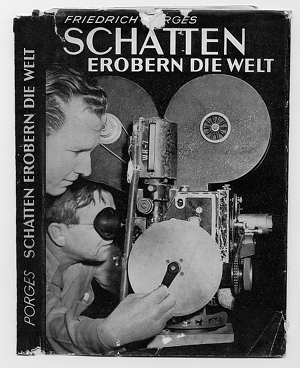
"Schatten erobern die Welt -
wie film und Kino wurden"
[Shades conquer the world ]
by Friedrich Porges
published in 1946 by Verlag für Wissenschaft, Basel |
 |
VORWORT
Wer weiss um die Geheimnisse der Welt? Wir ahnen, dass eine ordnende Macht Planeten und Gestirne in regelmässigem Wandel um die Sonne hält. Die Wissenschaft hat allerlei aufbauende und zerstörende Kräfte in der Natur entdeckt und sie entweder dem Wohl der Menschheit dienstbar gemacht oder sie den Selbstmordwaffen der Völker zugesellt. Wir stehen am Anbeginn einer Epoche, die mit der Zersplitterung der Atome neue Geheimnisse der Natur preisgeben wird. Das atomische Zeitalter scheint von den Wissenschaftlern als die letzte Station auf dem Weg zu rest- loser Enthüllung kosmischer Verborgenheiten betrachtet zu werden. |
FOREWORD
Who knows about the secrets of the world? We anticipate that an ordering power holds planet and stars in regular change around the sun. The science has discovered all kinds of constructing and destroying forces in the nature and has done them either to the well-being of mankind or has joined them to the self-murder weapons of the peoples. We stand at the beginning of an era which will reveal new secrets of the nature with the Zersplitterung of the atoms. The atomic age seems to be considered by the scholars as the last station on the way to complete exposure of cosmic seclusion.
[ This is a computer generated translation !
We shall welcome any better translation ]
|
|
Und doch, -die über uns waltende, uns unbekannte Macht und Grösse, von deren Wirken sogar das Leben des Individuums be-einflusst ist, schenkt den Menschen das Wissen um diese Welt nur nach und nach, in kleinen Dosen. Und sogar die WissenschaftIer selbst, die Lebensarbeit an Entdeckung und Erfindung setzen, kommen nur ganz langsam -im Laufe von Jahrzehnten und Jahrhunderten -zu entscheidenden Erkenntnissen.
Das Mittel, mit dem die Allmacht den Menschen in die Geheim- nisse der Natur einweiht und seine wachsende Klugheit und Reife erprobt, ist -der Zufall!
Wir nennen es Zufall, wenn Ueberraschendes zu Gutem oder zu Bösem uns begegnet.
Allein, es ist nicht Zufall! Es gibt vermutlich keinen Zufall, der sinnloses Geschehen und Resultat zeitigt, in grossen Dingen nicht .und nicht in anscheinend unwichtigen.
Im Alltagsleben des Einzelnen wird Zufall zu Bestimmung. Zufall gibt unserem Dasein oft entscheidende Wendung. "Zufall" lenkt Schicksal !
In der Wissenschaft und Forschung bringt Zufall immer einen logischen Schritt nach vorwärts in der Entwicklung einer Theorie oder einer Technik. Und das macht den Zufall so verdächtig als eine Art von vorbereitetem, geplantem Wink und Ratschlag --, so deutlich, so überraschend klar sich einfügend in das Wesen einer vorbedachten Ordnung irn Kosmos!
Es kann freilich nicht die Aufgabe dieses Buches sein, einer neuen Welt- und Naturphilosophie Ausdruck zu geben, obgleich es in seiner leichten, fast spielerischen Weise immerhin Einblick in das Wirken höherer Naturkräfte gewährt, -- dem, der zu schauen verstcht.
Was hier erzählt wird, ist ein Abschnitt aus der Entwicklungsgeschichte einer einzigen Technik, die dazu berufen war, eines Tages sogar Literatur und Kunst und Musik zu neuern packendem Ausdruck zu verhelfen: der Kinematographie.
Auf dem Wachstumsweg dieser wissenschaftlich begründeten Technik erschien immer aufs neue der "Zufall" als ein pfadfinder und Ratgeber, bis Forscher und Techniker, seinen Winken und Anweisungen folgend, zu wertvollen Erkenntnissen gekommen waren.
Abzweigungen der Hauptstrasse, auf der die Erfinder zu dem Effekt des lebenden und tönenden Bildes gelangten, führten zum Radio und zur Bildtelegraphie. Bis eines Tages die Seitenpfade sich mit der Hauptlinie wieder vereinigten und eine neue, kom- binierte Technik ins Leben trat, die ihren vorläufigen Höhe- punkt irn ferngesendeten, tönenden Bild, in der Television ( dem Fernsehen) gefunden hat.
Das Jahr 1946 wird der Markstein des Beginns einer Epoche der Fernsehtechnik und Fernsehkunst sein, denen sich auch noch der Film als Telefilm, Fernsehfilm, zugesellen wird. Das Fern- seh-Kino, wie es in London bereits irn Jahre 1939 zu praktischer Erprobung kam, kann als die nächstfolgende Stufe der Entwicklung einer Technik und einer Kunst betrachtet werden, deren Ursprung sich auf Jahrtausende zurückverfolgen lässt, da primitive Schatten als ihre Herolde und Vorläufer in Erscheinung traten.
Dies ist nicht eine trockenem Tatsachenmaterial folgende Geschichte der Kinematographie, die "Vom Schattenbild zum Fernsehbild" betitelt sein müsste. Was hier erzählt wird beginnt mit einer "Geschichte des Zufalls und seiner Folgen", des Zufalls, der auch in dem vorliegenden Fall der Kinotechnik zum mysterisen, geistigen Urheber technischer Erfindungen und ihrer Verbesserungen geworden ist.
Freunde des Films und Leute, die auf eine nicht zu beschwerliche und beschwerende Weise ihr Wissen um den Gegenstand zu erweitern wünschen, werden aus den einfachen "Geschichten", die da erzählt sind, sich selbst die "Geschichte" des Films und der Kinematographie bauen und zurechtlegen können, wobei Zusatzbemerkungen und Illustrationen ihnen zuhilfe kommen werden.
Und es ist nicht bloss die Geschichte einer Technik, sondern die Entwicklung einer Kunst, deren weltumspannende Bedeu-tung auch für die Erziehung der Massen und für das gegenseitigeVerstündnis der Völker dieser Erde von Tag zu Tag wächst.
Zufälle haben den "Schatten" zum universalen, auf tausende vonMeilen sichtbaren und hörbaren Sprecher und Befürworter eines dauernden Friedens auf Erden gemacht.
Wer zweifelt noch an ""Zufällen"" als Teilgaben in Vorbereitung des "grossen Geschenks", das am Ende der Menschheit noch wird ?
Es geht nur noch darum, dass die Menschen richtig verstehen, was ihnen in den Schoss gefallen ist und die Gaben nicht zumFluch, sondern zum Segen der Menschheit anwenden!
Wie zum Beispiel den Film, Bild und Ton und Wort weltferngesendet, als Künder eines Zeitalters der Erhebung, der Freude und des ungeteilten Friedens unter allen Völkern der Erde, den keine atomische Kraft zerstören soll und darf!
Hollywood, Herbst 1946
Friedrich Porges |
|
And, nevertheless, ruling, us unknown power and the size by whose work even the life of the individual is affected gives to the persons the knowledge around this world only gradually, in small boxes. And even the knowledge sheep animal which set life work on discovery and invention, come only completely slowly in the course of en and to to centuries crucial knowledge.
The means with which the omnipotence initiates people into the secrets of the nature and tests its growing cleverness and maturity is the chance!
We call it chance if surprising to good or to bad evil meets us.
Alone, it is not a chance! There is probably no chance which produces senseless events and result, not in big things and not in apparent unimportant.
In everyday life of the separate chance becomes determination. Chance often gives our existence crucial idiom. "Chance" steers destiny!
In the science and research chance always brings a logical step after forward in the development of a theory or a technology. And this does the chance so suspiciously as a sort of prepared, planned sign and advice-, so clearly, so surprisingly obviously adapting in the nature of a before-considered order in cosmos!
The goal of this book can not be, of course, to give expression to a new world and nature philosophy, although it grants, nevertheless, look at the work of higher natural forces in its light, almost playful way, - to look he verstcht.
What is told here, is a section from the history of the development of a single technology which was developed to help one day even literature and art and music to a new packing expression: the cinematography.
On the growth way of this scientifically reasonable technology the "chance" appeared always afresh as a boy scout and counselor, to researcher and technical engineer, to its signs and instructions following, to valuable knowledge had come.
Forks of the main street on which the inventors got to the effect of the living and sounding picture led to the radio and to the picture telegraphy. Since one day the side paths reunited with the main line and a new, combined technology stepped into the big which has found their(her) temporary climax irn far-sent, sounding picture, in the tele vision (television).
1946 will be the landmark of the beginning of an era of the television engineering and television art to which also still the film will join as a tele film, telefilm. The far-visual cinema how it came in London already in 1939 for practical test, can be considered the next step of the development of a technology and an art the origin of which can be traced back on millenniums, because primitive shades appeared as their heralds and precursors.
This is no dry fact material the following history of the cinematography which would have to be given a title " by the silhouette to the television picture ". What is told here begins with a " history of chance and its consequences ", the chance which has also become in the present case of the cinema technology the mysterious, mental author of technical inventions and their(her) improvements.
Friends of the film and people, in a not too cumbersome and weighting way their knowledge around the subject wish to extend, become from the simple "stories" which are told there, can be founded the "history" of the film and the cinematography and arrange and addition observations and illustrations to them zuhilfe will come.
And it is not only the history(story) of a technology, but the development of an art whose global importance(meaning) also grows for the education of the masses and for gegenseitigeVerstündnis of the peoples of this earth from day to day.
Chances have the "shade" to the universal, on thousands of vonMeilen visible and audible speakers and advocates of a peace on earth made to last.
Who still doubts "chances" as partial gifts in anticipation to the "big present" which becomes at the end of mankind still?
It goes only about the fact that people understand correctly what they liked in the shot and the gifts not zumFluch, but apply to the blessing of mankind!
As for example the film, picture and sound and word weltferngesendet, as a Künder of an age of the elevation, the joy and the undivided peace among all peoples of the earth which no atomische force should destroy and may!
Hollywood, autumn, 1946
Friedrich Porges |
|
|
|
|
FRIEDRICH PORGES
by Nasila Berangy
March 17, 2004
TABLE OF CONTENTS
Introduction
- Friedrich Porges
- Letter to Robert Neumann
- Correspondence between Mimi Grossberg and Friedrich Porges
- Analysis of the Correspondence
INTRODUCTION
The present work deals with the biography of the late exile journalist, writer, director, and screenwriter Friedrich Porges.
The literature research proved to be quite difficult, contrary to all expectations. Although Porges was a constantly working person and was able to fulfill himself professionally, very little has nevertheless been published about him. Both on the internet and in most reference works and encyclopedias, no complete biography could be found. Unfortunately, the Austrian P.E.N. Club, of which Porges was once a member, could not provide any information about him, since the National Socialists burned all documents. As a result, the P.E.N. Club has no information available about former members. The Cultural Information System of the Austrian Federal Ministry for Education, Science and Culture was equally unable to provide information about Porges' biography. The Jewish Museum and its archive also have no information. The same applies to the American Consulate and the American Research Center in Vienna. The following American libraries, archives, and institutions were contacted: Jewish Historical Society of Southern California, Leo Baeck Institute, YIVO Institute for Jewish Research, American Historical Society, Wiesenthal Institute, NYPL Institute. The latter charged $75 per hour for research. None of the others had any information about Porges. The magazine Aufbau, for which Porges worked until shortly before his death, did not respond to repeated inquiries. The same goes for Voice of America (where Porges also worked in the editorial department) and the Fischer Verlag in Germany. The Austrian newspapers and magazines for which Porges regularly wrote articles also have no information.
It has been a laborious task to gather material on Porges' biography, since he mostly worked anonymously. Nevertheless, a few sources of information could be found. A good overview of Porges' works is offered by the website www.porges.net. My special thanks go to the staff of the National Library catalog, with whose help I found the microfilm data on Porges. The exile library of the Austrian Literature House also turned out to be a treasure trove. There I found the correspondence of Mimi Grossberg, herself an exile journalist who had once been driven out of Austria, with Friedrich Porges. Parts of this correspondence have been deliberately reproduced verbatim, since this best conveys an impression of Friedrich Porges as a person—for example, his meticulous precision when it came to data about himself, or his active role in both European and American journalism.
As agreed in the letters, Grossberg sent Porges a copy of the text she had written about him, which was to appear in a catalog of Austrian authors and writers. Of particular interest for the present work is Friedrich Porges' exact date of birth: July 14, 1890. There is much speculation about his date of birth in the secondary literature. 1896 or 1906 are two frequently cited birth dates. Through the correspondence, this error could at least be ruled out.
Friedrich Porges was a regular contributor to the exile magazine Aufbau until shortly before his death. Under the column "Man about Hollywood," he wrote his texts about events in Hollywood.
1. FRIEDRICH PORGES
Friedrich Porges was born on July 14, 1890 in Vienna and died on January 24, 1987 in Los Angeles. Born as the son of the banker Ludwig Porges and Victoria Bing, Friedrich Porges studied modern philology at the University of Vienna for four and a half years. Already during his studies, Porges was interested in journalistic work and consequently wrote for various magazines. At the same time, he pursued philosophical and literary-historical studies, until he later worked as an external contributor and theater and feuilleton editor for the daily newspapers Die Zeit and Der Morgen. In 1917, as a dramaturg at the Sascha film company, he wrote several screenplays for silent films, including:
Die Liebe eines Blinden (The Love of a Blind Man, together with Fritz Freisler)
Der neue Tantalus (The New Tantalus)
Das schwimmende Herz (The Floating Heart)
1.1 FRIEDRICH PORGES: HIS WORKS
From 1921, he himself directed several films:
Die Macht der Mary Murton (The Power of Mary Murton) with Anita Berber, 1921.
Der Marquis von Bolibar (The Marquis of Bolibar), based on a novel by Leo Peritz, 1922
Die Tochter des Brigadiers (The Brigadier's Daughter, after Alexandre Dumas), 1922
Das verlorene Paradies (Paradise Lost), 1923
Der Film im Film (The Film within the Film), also 1923
Adam und Eva (Adam and Eve, no date available)
Alles will zum Film (Everyone Wants to Be in Movies) with Nora Gregor, 1927, is one of his best-known works.
In 1922, in addition to his directing activities, he continued to work as editor of the Wiener Sonn- und Montagszeitung. In 1924, after a two-year stay in Berlin, where he had been engaged as deputy editor-in-chief of Montagmorgen, Porges returned to Vienna and edited the magazine Bühne.
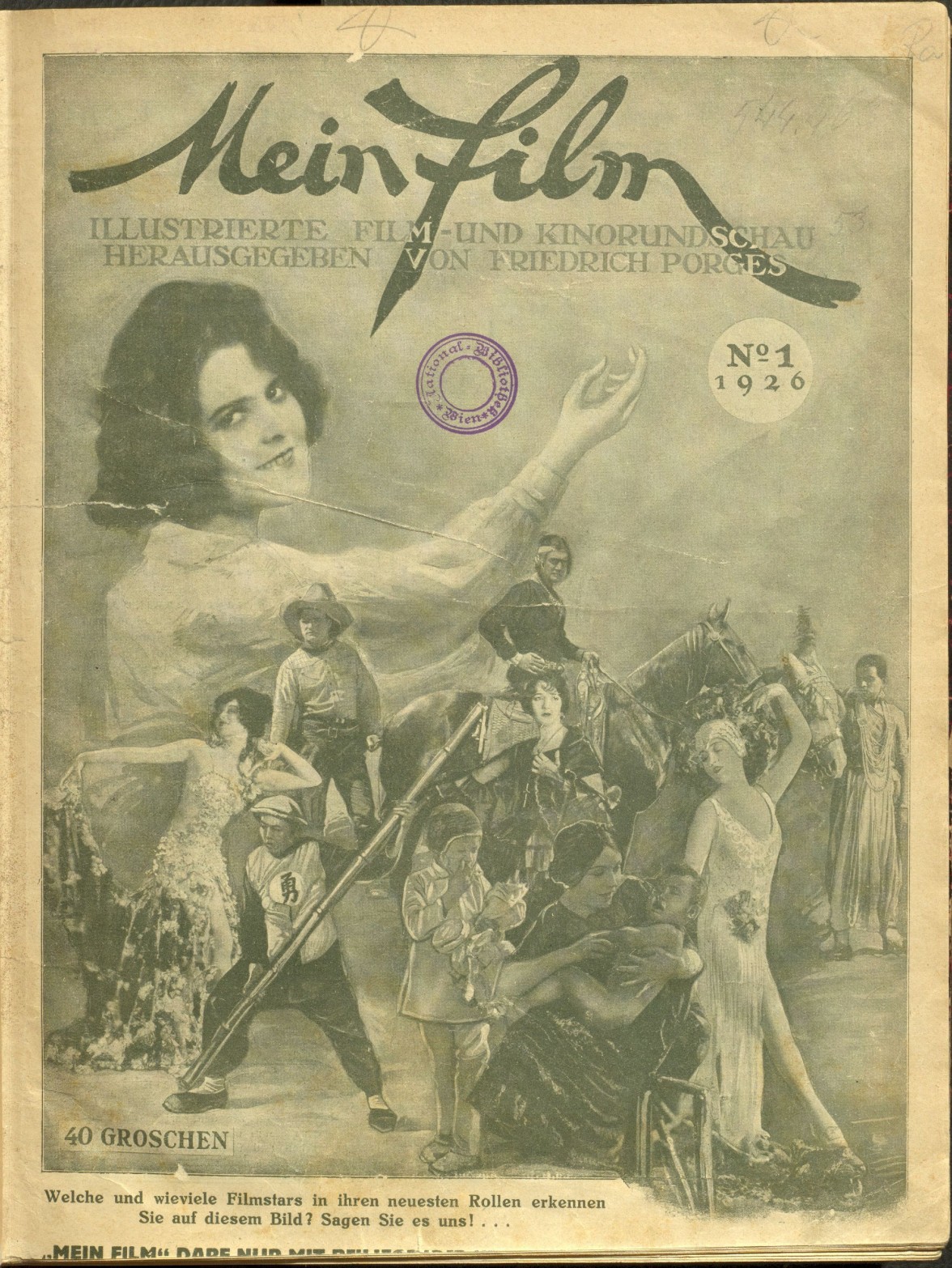
In 1925, Friedrich Porges co-founded and was editor-in-chief until 1938 of the very popular film magazine Mein Film – Illustrierte Film- und Kinorundschau. In 1927, he also published Mein Film-Buch.
In addition to his journalistic work, Porges also wrote several books:
The Dramas:
Licht (Light), 1908
Die Helden (The Heroes), 1909
Der tote Wille (The Dead Will), 1910
Einakt (One Act), 1913
Der wunde Punkt (The Sore Point), 1917
Cherchez la femme, also 1917
Der Gast von anderswo (The Guest from Elsewhere), 1918
50m Kinoweisheit (50m of Cinema Wisdom), 1919
Einbruch (Break-in), 1920
Novels and Short Stories
Der Sprung ins Dunkel (The Leap into the Dark), 1913
Die Liebe des Thomas Hill (Thomas Hill's Love), 1920
Das doppelte Ich (The Double Self), 1921
Revolution, 1924
Ein junger Mann sucht Abenteuer (A Young Man Seeks Adventure), 1924
Don Juans Abweg (Don Juan's Wrong Path), 1925
Sie will zum Film (She Wants to Be in Movies), 1926
Das Harry Liedke Buch (The Harry Liedke Book), 1928
Vom Film, von Filmstars und von Kinematographie (On Film, Film Stars, and Cinematography), 1928
Mensch in Fesseln (Man in Chains), 1930
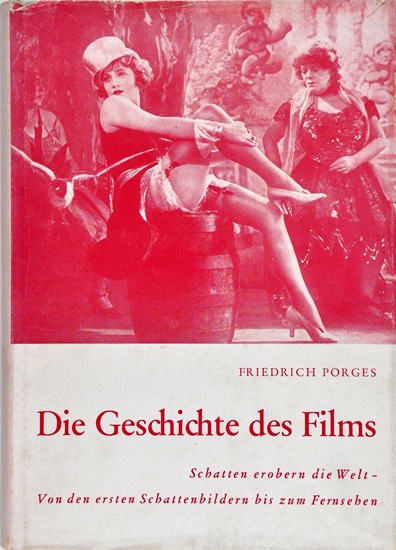
Schatten erobern die Welt: Wie Film und Kino wurden (Shadows Conquer the World: How Film and Cinema Came to Be), 1946 in Basel.
Fortissimo, his fourteenth novel, was the first he wrote in English in addition to German.
His book Schatten erobern die Welt leaves room for interpretation regarding its content. One could conclude that it alludes to the Nazis. In fact, however, it is again only the history of film. Readers were to be granted a glimpse behind the scenes, and it was meant to be an educational film about the development of cinematography. In some scenes, directors can be seen at work shooting films.
1.2 FRIEDRICH PORGES: HIS LIFE
Porges was a successful journalist, writer, and director in Vienna. His Vienna address was: 1090 Vienna, Eisengasse 23, with the telephone number A-17-3-72. Before National Socialism, no political publications by him could be found. He was devoted to film. All his attention was focused on film. In 1938, Porges was forced to leave Austria due to the political circumstances. He was able to escape just in time and fled via Zurich to England, where he continued his work as a journalist. Unfortunately, no further details are available, such as difficulties obtaining a visa, acquiring the English language, whether he had support from friends and family in England, whether he went to England alone, or whether his family was also able to bring themselves to safety.
There is unfortunately no mention of his wife Helene Matzner. It remains unclear whether she and the two children, Stella and Erika, accompanied him to England. Did the children perhaps come on the Kindertransport? It also remains a question whether his family even survived National Socialism. His two daughters were mentioned in only one source. Since he had two daughters, there is the possibility that they changed their name after marriage.
In 1943, Porges emigrated to Hollywood and began his decades-long reporting for the exile magazine Aufbau and worked as a correspondent for numerous European newspapers, magazines, and radio stations, as well as for the film magazine of the Austrian Broadcasting Corporation. In 1959, he received the Dimitri Tiomkin International Press Award for the best Hollywood story of the year. The Hollywood Foreign Press Association elected Porges president of the association for the first time in 1948, later in 1954, and one last time in 1957.
Porges was forced to give up his professional activity due to an eye condition. He was a member of the Austrian Section of the Screen Writers Guild.
Friedrich Porges died on January 24, 1978 in his home in Los Angeles and was buried at Hillside Memorial Park.
His name appears on the compensation list of the ICEP investigation of 2001; his descendants now know that they are entitled to make claims.
1.3 FRIEDRICH PORGES: THE EDITOR
In 1925, Porges co-founded and was editor-in-chief until 1938 of the weekly magazine Mein Film – Illustrierte Film und Kinorundschau.
The magazine was 16 pages long and cost 40 groschen in the first year, after which it was raised to 50 groschen. The editorial office was located at A-1060 Vienna, Mariahilferstraße 85.
The focus, as the title already suggests, was on film. The program of Vienna's cinema theaters was included. A large portion was devoted to introducing the actors and actresses. Since the technology at the time only allowed black-and-white films, the column "Steckbriefe" (Profiles) was created. Here, in addition to the precise personal details of favorite film stars, readers were also given specifics about their appearance—particularly eye and hair color.
Furthermore, fans were given tips and tricks on how to meet a star. Readers were additionally offered numerous ways in which they should approach a star to gain their attention.
Porges himself was a great fan of Charlie Chaplin and followed his career very closely, so regular reports about his films could be read, but Chaplin's private life was also examined under the microscope.
In the column "Letters to the Editor," space was given to actors to express their opinions—which, by the way, were always positive—about the magazine. Conrad Veidt wrote: ...the editor, who lives in constant best understanding with most of our beloved film actors and may count one or another as part of his circle of friends...
In another issue, actors were asked whether they themselves even went to the cinema. Actresses such as Mady Christians and Lucy Doraine declared their preference for cinema films. But it was equally important for the actresses to have seen the work of the competition.
The magazine Mein Film was so successful that Porges decided to publish a film book annually. Mein Film-Buch was published by Mein Film Verlag, the film, book, and newspaper publisher of the illustrated film and cinema review Mein Film, at 1060 Vienna, Mariahilferstraße 85. Thus, in December 1926, he wrote in the foreword of Mein Film-Buch that not only the concept of film would be addressed, but also the development of the technology that led to film. So there were regular reports on the developmental history of cinematography or the emergence of sound film. Further content included portraits of film artists, their discoverers, their best-known films, and their home addresses. Thus, it could be learned that Charlie Chaplin lived at 1416 La Brea Ave, Hollywood, California. A great wish of Porges' readership was thus fulfilled.
However, Porges wanted to address both cinema fans and cinema makers with this project: film directors, since the pictures and addresses of national and international stars were available. The film commercials could see from the film book which producers were currently leading. Furthermore, Austrian film companies and film societies with addresses were introduced. The film actor could be informed about both factual and personal matters of interest. For all those who harbored the dream of acting, Porges wrote an article, since several people had approached him asking for his advice. He lamented that now everyone wants to be in films. One must, however, consider whether the necessary talent and the necessary camera presence are even available. Thus, Porges emphatically warned against film school swindlers, since in his view, the profession of actor cannot be learned in a school.
Prominent representatives of the film industry were also present in Mein Film-Buch. Marlene Dietrich wrote about her film work in Hollywood, that the film metropolis is the sole ruler that reigns absolutely: Hollywood is a peculiar city, sober reality and fairy-tale unreality have merged into a fascinating unity.
Porges' acquaintances with many celebrities may have been one reason why he was able to gain a foothold in Hollywood so quickly.
1.4 FRIEDRICH PORGES: THE CRITIC
Unfortunately, there is hardly a biography of Friedrich Porges that is longer than one A4 page. But there are enough biographies of other exile journalists and writers in which Porges' name appears. Porges wrote many reviews of films and literary works for Aufbau. Among other things, he wrote a review of Hans Kafka's opera libretti Leonce und Lena, based on Georg Büchner's play. In it, he praised Kafka's work as an independent literary creation and an extremely effective libretto for a comic opera, full of cheerful liveliness. The work betrays the hand of an experienced playwright and excellent dialogue writer. Kafka contributed much that is intellectually interesting and satirically witty.
Another review was written by Porges after a conversation with Frederick Kohner about his work: Kiki of Montparnasse is an original and literarily remarkable narrative.
About Henry Koster's film career, Porges wrote in retrospect: Decisive for the development of his career in Hollywood was, however, the primitive beginning on the Universal grounds. For there, Koster wrote the screenplays for the first films that not only established a firm position but also formed the start of the rise of a young actress and singer: Deanna Durbin, who played the lead role in the first three Universal films written and directed by Koster: Three Smart Girls, 100 Men and a Girl, and Three Girls Grow Up.
In the last review, Porges refers to the fact that all exiles lost the status they had at home in one fell swoop. They had, like Henry Koster, to start from scratch; some made the climb, others were forced to take up a different profession.
1.5 FRIEDRICH PORGES: HIS WORK AT AUFBAU
The exile magazine Aufbau was founded in 1934 and reflects the history of German-Jewish emigration.
For exiles, emigration meant the loss of homeland and thus also the loss of security and protection. For journalists and writers, there was also the loss of language and therefore the loss of intellectual creativity. In Aufbau, many of the exile journalists found a way to take up again what had been lost. So did Porges. From 1943 onwards, he wrote regularly for Aufbau. Under the column "Westküste" (West Coast), his reports appeared on events in Hollywood and, of course, also on film and the participating actors and actresses. Then as now, rumors about film stars arise when their latest film comes to theaters—for the purpose of propaganda. Porges did not let it pass without examining this phenomenon, and wrote about the female Exorcist actresses who were dueling for the public's attention.
Unfortunately, very few texts by Porges with political content could be found. Only in 1950 did Porges write in his usual column "Rund um Los Angeles" (Around Los Angeles) that an International Center was to be opened in the heart of Los Angeles. To make the coexistence of the various ethnicities living in Los Angeles more harmonious and peaceful, the center was to open grocery stores from all countries. And the restaurants would attract customers with the dishes of various countries. Likewise, museums were planned to display valuable national objects and treasures. Porges did not doubt that this project could work for Mexicans, Indians, and Africans, but certain elements, Porges wrote, had accumulated in Los Angeles in recent decades that did not know the word peace, and their role models and teachers had already proven this in Central Europe. Porges further complained that these people had used the 100th anniversary of Los Angeles as an occasion to deface Jewish temples with swastikas. At the same time, Porges expressed his gratitude to the Americans for their support.
About the films of the Nazis, Porges wrote that they lagged years behind in technology and quality.
Friedrich Porges also wrote for Aufbau in English. He documented the Oscar Night and the events of the night for his readers in English.
2. LETTER TO ROBERT NEUMANN
On June 28, 1939, Porges wrote from London (38, Priory Road, London N.W.6. MAI 7706), where he had found refuge, a letter to Robert Neumann. Porges asked him for support:
Dear Dr. Neumann,
We have probably not met for an eternity—I have been in London for nine months, was previously in Italy and Switzerland, after I had enjoyed three and a half months of Hitler's rule in Vienna—but I assume that you cannot remember me.
I am writing these lines in the interest of Dr. Robert Weil. He had received information from you in February that one could apply for his admission to the P.E.N. Club if two club members vouched for him. Now I would like to help Dr. Weil, who wants to come to England. I was a member of the Vienna section of the P.E.N. Club. So can I be a guarantor? I will then try to find a second one.
However, it is not entirely clear to me whether the club, even if Weil becomes a member, can help him with his entry here. Is it possible to help Weil in this regard?
May I therefore ask you for your information, so that I am in a position to give an answer to the man, who allegedly is only allowed to remain in Switzerland for a few more weeks?
With warmest greetings
Yours, Friedrich Porges
[I would be grateful if you could send me] a letter from the P.E.N. Club, so to speak, with information about me.
With thanks and many warm greetings
Your devoted
Friedrich Porges
Dr. Robert Weil, about whom we corresponded at the time, has meanwhile traveled via London to New York.
Exiles tried to support each other as well as possible. Thus, the lines that Porges addressed to Neumann were no rarity. 3. CORRESPONDENCE BETWEEN MIMI GROSSBERG AND FRIEDRICH PORGES
On August 21, 1968, Mimi Grossberg (81 Wadsworth Terrace, New York, N.Y. 10040) first contacted Friedrich Porges to inquire whether he would like to be included in the catalog she was compiling for the Austrian Institute, titled Austrian Writers in the United States 1938 – 1968, for which a supplement was planned. The exhibition Geschick und Leistung der österreichischen Emigranten von 1938 in den Vereinigten Staaten (Fate and Achievement of the Austrian Emigrants of 1938 in the United States) was organized in cooperation with the Austrian Forum.
Grossberg was herself one of those affected by this group and had to leave Austria during the Nazi regime. In the USA, she likewise found her second home. She was particularly committed to this project and gave a speech about the fate but also about the creative work of the Austrian exile poets and authors.
Grossberg sent the letter to Porges through Aufbau, since she did not know his address.
For the catalog, fictional literature but also studies were of particular interest. Grossberg's mistake of describing Porges' work Schatten erobern die Welt as a short story made Porges somewhat annoyed:
His reply followed on September 2, 1968 (12130 Hollygien Place, Studio City, California 91604, Tel: 763 – 1982):
...I thank you for your letter of August 21. Since I was again very busy last week, I am unfortunately only getting around to answering it today.
The thing about the short story is, of course, nonsense. Schatten erobern die Welt was a full-grown book. The error probably comes from the fact that in the book, the development of film is told in entertaining, belletristic stories. However, it is not technical but fictional literature.
It is true, of course, that no book of mine came out afterwards, but in 1939 in London I wrote a new radio play, Der Kuss in die Ferne (The Kiss into the Distance), which was broadcast to Switzerland that same year. I had, as you probably know, previously written a whole series of radio plays.
I continued my literary activity in 1943 in Hollywood as a film author. I also worked, as a script editor, on several screenplays, in almost all cases anonymously. I was also active in television. Soon after the war, however, I began to work as a Hollywood correspondent for European newspapers. And since my journalistic activity for numerous magazines, daily newspapers, and radio stations expanded enormously, I simply could no longer find the time and concentration to write books, and for the time being I still see no possibility of taking up this work, although I have the intention of doing so.
My studies in Vienna: elementary school, gymnasium (Döbling and Landstrasse) and four and a half years of modern philology at the University of Vienna.
Emigration stations: 1938 from Vienna to London (via Zurich) and 1943 from London to Hollywood.
I hope that this information is useful to you and send you my best regards
as your
Friedrich Porges
Mimi Grossberg replied on November 4 and immediately sent Porges a carbon copy (unfortunately not included in the correspondence) with the information about Porges, with the request to correct any gaps or misreports.
The English catalog was no longer to be supplemented, but the exhibition would be shown in October 1969 as part of the Austrian Book Week in Vienna, Grossberg wrote. In this connection, she asked him for two addresses of authors that Porges might know, such as Paul Frank and George Froeschl, and addressed the following words to Porges:
...For the smallest help I will be especially grateful, because I need this information in the service of the matter of Your literature, and they will serve in many countries to supplement the material already available. I myself work without pay, therefore I consider myself entitled to also ask others for their support. This is in all our interest. – I know you are very busy, but I hope that you will let me know with two lines about news whose finding does not cause you difficulties! Above all, also any corrections or additions to the paragraph about you.
Friedrich Porges on November 18, 1986:
...Please forgive me that I am only getting around to answering your letter today. But the past ten days have been full of work, press conferences, film premieres, etc. And then the reporting. It was breathtaking!
Here are the requested addresses:
Mr. Paul Frank: 1517 N. Orange Grove, Los Angeles 46, California
Dr. George Froeschl: 1146 San Ysdiro Drive, Beverly Hills, California
Enclosed is the carbon copy (unfortunately not present) of the biographical information with two corrections:
Since then he has lived (as a film author and script doctor – please omit!) in Hollywood. (At the end you write anonymous collaboration in Hollywood and that is correct.)
As for my articles in AUFBAU, they are not "almost regular," but very regular, since I do supply the West Coast supplement from Los Angeles and Hollywood with material, that is, with reports and articles. So, please omit "almost."
You don't need to refer to me at all with Frank and Froeschl. Otherwise they will inquire with me. And you can explain better than I can what it's about!
Mimi Grossberg replied on January 2, 1969, and thanked him for the addresses. The director of the Austrian Institute in New York (address: 11 East 52nd Street, New York 10022), Dr. Gottfried Heindl, needed for the catalog a portrait photo and a so-called manuscript page, to illustrate the way Porges worked. Heindl produced the display boards—and on each are a photo, a manuscript page, and the bibliographic notes cut out from the catalog..
Friedrich Porges replied on January 31, 1969:
...I actually wanted to write to you immediately upon receiving your letter from early January, but then so many special assignments came in for me from my European newspapers that everything else simply had to be set aside.
However, I have an urgent request to make of you: When rereading the copy of my letter with the information for you, I had written about my activity as a film writer that, in addition to my own manuscripts, I also collaborated for colleagues. I had chosen the word "anonym" (anonymously). In the notes you then wrote for the catalog, you had taken that over from the dictation, and you then, hopefully at my request, omitted it. But I now find in retrospect that the word "anonym" sounds bad and misleading, which I had chosen. And I would therefore be very grateful to you if you would simply state, instead of the previous text, that I collaborated on film screenplays, and would omit the word "anonym." It matters a great deal to me that the word be removed. Perhaps you could send me, if possible and if it is not too much trouble for you, that copy of your information once more. And I can then properly edit the whole thing. The first time I was in great haste when I went through the copy. Incidentally, are these data also included in the English catalog or only in the German one?
Secondly: the material for the Austrian Institute. I have a small portrait photo, only the one with the manuscript page is somewhat complicated. I no longer have my earlier manuscripts, of course. My way of writing belletristic work is: on small sheets in handwriting. The only possibility would be to add a manuscript page from my memoirs, on which I now write from time to time, when I find a few hours for it.
It is embarrassing to me that I have not yet sent anything to Dr. Heindl. But that will be done immediately upon receiving your reply.
By the way, do you have in your bibliographical entries Der tote Wille, Schritt ins Dunkel, Die Liebe des Thomas Hill, Mensch in Fesseln?
On February 4, Mimi Grossberg wrote to Friedrich Porges for the last time according to the available correspondence. She sent him the corrected page once more as requested, and also crossed out the word "anonym." However, the two works of Porges with the titles Der tote Wille and Schritt ins Dunkel were unknown to Grossberg. Since he had also not given a time period, she could no longer include them in the work. Once again, Grossberg had to ask Porges to send the photo and the manuscript page to Dr. Heindl, since it was already much too late for it.
The final excerpt about Friedrich Porges in the German catalog that Mimi Grossberg had sent to Friedrich Porges does exist, but is not reproduced verbatim here as the correspondence was, since the information contained therein has already been mentioned! 3.1 Analysis of the Correspondence
As already mentioned in the introduction, the parts of the correspondence between Mimi Grossberg and Friedrich Porges were included in the work because part of Friedrich Porges as a person should be incorporated into the work. Another reason is, of course, that certain pieces of information that had previously been uncertain thereby found full confirmation.
For example, his first reply letter of September 2 to Mimi Grossberg. He writes that he is again very busy. In the literature, it was often read that exile journalists had no or few chances to continue their profession in foreign lands. Friedrich Porges is a good example that some Austrian journalists succeeded in gaining a foothold even in exile and could continue to successfully practice their profession. However, it must be added that Porges did not have to overcome any linguistic barriers. He wrote his last novel, Schatten der Leidenschaft (Shadows of Passion), in both German and English.
Another valuable piece of information is his work as a script doctor. It is especially valuable because, as he himself writes, he worked anonymously, and thus his name appears nowhere. Therefore, it is unfortunately not known on which films he collaborated.
In the letter of November 18, it becomes clear a second time that Porges is a very busy journalist in Hollywood and that he probably also enjoys the great deal of work, or as he himself writes, finds it "breathtaking."
A further essential point that should receive attention here for the first time is his concern for a careful and detailed description of his person.
On January 31, Porges wrote again to Grossberg. Here, too, he writes again about how busy he is. Porges asks Grossberg a second time to delete words that he himself had chosen about his work, such as the word "anonym." 4. SUMMARY
For a precise research of the key data on Friedrich Porges' works—but above all his life after Austria—a stay in Los Angeles and New York would be useful and enlightening. In the correspondence with Mimi Grossberg, Porges wrote, for example, that he was working on his memoirs and even sent a manuscript page to the Austrian Institute. Unfortunately, these memoirs have remained unpublished to this day. Questions that still remain unanswered can only be answered by Friedrich Porges himself or his descendants. It is very astonishing why there is so little literature about his life. Why has no one tried to reconstruct his life to this day? Unfortunately, the editorial staff of Aufbau did not respond to the e-mails for the present work.
Friedrich Porges was an extremely active man and continued working until shortly before his death. He had devoted himself to film and remained faithful to it with few exceptions. This may also be the reason why only a few texts in which he expressed himself politically could be found.
It seems that his good relationships with prominent people in Hollywood may have contributed to his not having to overcome any professional obstacles. These are, of course, only assumptions; the answers remain owed to us by Porges' memoirs... BIBLIOGRAPHY
Dietrich, Marlene: Hollywood. In: Mein Film-Buch. Vienna 1932, pp. 14-15
Doraine, Lucy; Christians, Mady: Briefe an den Herausgeber. In: Mein Film. Illustrierte Film- und Kinorundschau. 1926, No. 7, p. 3
DW: Ulrich, Rudolf: Österreicher in Hollywood. Ein Beitrag zur Entwicklung des amerikanischen Films. 1st edition, Vienna 1993, Austrian State Printing Office, p. 225
DW: Petitions for support by Austrian emigrants in England to Robert Neumann for monetary allocations. Index cards 7246, June 1939
Friedrich Porges. In: Stadt Wien, No. 59, 27.7.1966, p. 5
Horak, Jan Christopher: Fluchtpunkt Hollywood: Eine Dokumentation zur Filmemigration nach 1933. Münster – Maks Publications, 1986, p. 118
Porges, Friedrich: Henry Koster – 60 Jahre. Und seit über 35 Jahre beim Film. In: Aufbau (NY), XXXI, No. 18, April 30, 1965, p. 24f.
Porges, Friedrich: Jugenderinnerungen an Kiki. In: Aufbau (NY), XXXIII, No. 51, December 22, 1967, p. 57
Porges, Friedrich: Man about Hollywood. Reporting. In: Aufbau. Die Westküste. New York, January 1943, Vol. XV, No. 2, p. 17
Porges, Friedrich: Opern-Uraufführung in Los Angeles. Leonce und Lena von Eric Zeisl. In: Aufbau (NY), XVIII, No. 22, May 30, 1952, p. 13
Porges, Friedrich: Rund um Los Angeles. In: Aufbau. Die Westküste. New York, September 22, 1950, Vol. XVI, No. 38, p. 19f.
Porges, Friedrich: Vom Chef zur sterbenden Wildnis. In: Die Zeitung. London, April 21, 1943, Vol. IIV, No. 320, p. 6
Porges, Friedrich: Vorwort des Herausgebers. In: Mein Film-Buch. Vienna 1927, pp. 3 – 6 and 383
Porges, Friedrich: Vorwort des Herausgebers. In: Mein Film-Buch. Vienna 1928, pp. 3 - 6
Porges, Friedrich: Zum Film wollen... In: Mein Film-Buch. Vienna 1932, pp. 25 – 36
Porges, Friedrich: Zwischenfall beim Teufel. Man about Hollywood. In: Aufbau. Die Westküste. New York, March 1974, Vol. XL, No. 13, p. 26
Mack, Gerhart: Frederic Kohner. In: Spalek, M. John; Strelka, Joseph (eds.): Deutschsprachige Exilliteratur seit 1933. 1. Kalifornien, Part 1, Berlin and Munich 1967, p. 768
Meierdorff, Marta: Henry Koster. In: Spalek, M. John; Strelka, Joseph (eds.): Deutschsprachige Exilliteratur seit 1933. 1. Kalifornien, Part 1, Berlin and Munich 1976, p. 777
NB (Catalog) Microfilm: Biographisches Handbuch der deutschsprachigen Emigration nach 1933. Vol. 2. 1983, p. 565
NB (Catalog) Microfilm: Degener, A. L. Hermann: Wer ists? Unsere Zeitgenossen. 10th edition, 1935, p. 345
NB (Catalog) Microfilm: Giebisch, H.: Kleines österreichisches Literaturlexikon. 1948, p. 531
NB (Catalog) Microfilm: Planer, Franz (ed.): Das Jahrbuch der Wiener Gesellschaft. 1929 edition, p. 383
NB (Catalog) Microfilm: Wieninger, Salamon: Große jüdische Nationalbiographie. Vol. 5, 1931, p. 494
Austrian Literature House, Exile Library: Horak, Jan-Christopher: Fluchtpunkt Hollywood. Eine Dokumentation zur Filmemigration nach 1933. Münster: MAKS Publications, 1984, pp. 2 – 36
Austrian Literature House, Exile Library: Correspondence between Mimi Grossberg and Friedrich Porges
70th Birthday of Friedrich Porges. In: Rathaus-Korrespondenz. Vienna, July 14, 1966, sheet 2224
Veidt, Conrad: Briefe an den Herausgeber. In: Mein Film. Illustrierte Film- und Kinorundschau. 1926, No. 3, p. 5
Röder, Werner; Hannuah, Caplan (eds.): Biographisches Handbuch der Emigration nach 1933. The arts, sciences and literature A-Z. Published by the Institute of Contemporary History Munich (et al.), Saur 1983, p. 920
Zohn, Harry: Franz Kafka. In: Spalek, M. John; Strelko, Joseph (eds.): Deutschsprachige Exilliteratur seit 1933. 1. Kalifornien, Part 1, Berlin and Munich 1976, p. 425f.
(Translated from the German original)
|