Lazar (Alois Porges) (b. 1813, d. 16/06/1898 (Friedhof Ybbs))
married
Josepha Mahler (=Rosenblüth, namensänderung 1900) (b. 1820, d. 25/04/1888)
Adolf Porges (b. 19/02/1862 Bohemia,
d. 02/06/1927 (Friedhof Ybbs), ) married to Therese (Theresia)
Heimer (b. 12/04/1870,
deported to Theresienstadt on 24/09/1942
ID. Nr 28.786. Lived in Scheibbs.
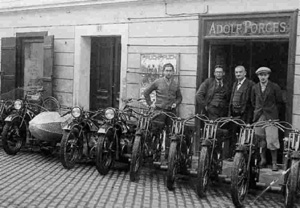
lived Vienna 2, Rotensterngasse 6. He owned a motorcycle shop.
Adela (Adelheid) Porges (b. 25/11/1893) married Singer. (went
to England) Children : Gretl, Stella Rudolf Porges (d. 1902) Hugo Porges, (b. 31/08/1897 in Scheibbs (Lower-Austria))
lived
Vienna 2, Rotensterngasse 6, deported to Theresienstadt on 24/09/1942. Hans Porges (b.16/07/1906)(went to Palestine), married 09/07/1933
Gittla Schwarz (b.10/11/1908,
dep. Maly Trostinec 31/08/1942,
d. 04/09/1942),
Evelyne (Eva) (b. 17/05/1935, dep. Maly Trostinec 31/08/1942,
d. 04/09/1942) Adolf Ferdinand (Adi) (b. 07/06/1937, dep. Maly Trostinec
31/08/1942, d. 04/09/1942)
Ernst Porges (b. 01/08/1908) (went to Palestine)
married Selma Paula Schneider (b. 10/11/1908, dep.31/08/1942
Elisabeth Porges (b. 01/06/1937 in Melk (Niederösterreich,
Lower-Austria),
lived Vienna 2, Rotensterngasse 8, deported
to Maly Trostinec on 31/08/1942
where she died on 04/09/1942)
Ferdinand Porges (d. 1891 St Pölten) Maria Porges (b. 06/08/1891)
Elizabeth (Lieserl) (b. St Pölten, 1937, d.?) (possibly the same person
as Elisabeth Porges above, b. 01/06/1937 in Melk — to be verified)
Gustav Porges (b. Scheibbs Austria 28/4/1892, d. NY 7/1961))
married 1919 to Jeanette Menzel-Wagschal (b. Cernauti Romania
11/11/1900, d. NY 8/1983)
survived the Tereienstadt KZ camp.
Paul Peter Porges (b. Vienna 7/2/1927, d. Kingston Jamaica 20/12/2016)) cartoonist,
married Lucie Eisenstab (b. Favoriten,
Vienna, Austria 23/11/1926, d. New York 17/06/2011)
They lived
in New York.
Claudia Porges (b. NYC 25/04/1956) married/divorced Scott
Holland
re-married Jean-Philippe
Beyer.
Kitt
Porges Holland (b. Santa Barbara 04/1985) married (15/07/2006)
Megan Elkins Katalina
J. Holland (b. NYC 12/1993) Maxime
Beyer (b. St Martin 1998)
Vivette Catherine Porges (b. NYC 24/03/1959) married Paul
Shorr. Lives in
NYC
Children : Evan Jack Shorr (b.NYC 14/05/1990), Ella Shorr
(b. NYC 13/07/96)
Kurt Porges (b. Wien 23/7/1920) married
Edith Wolff in 1949.
Worked as a printer for various newspapers ;
served the U.S.
Army in S. Pacific, New Guinea, Phillipines, Japan & Korea.
Michael A. Porges married Pamela Franklin
Matthew Franklin Porges
Jane T. Porges (Ben David), divorced. Lives in Hoboken (NJ)
(2006)
Simon Siegfried Porges (b. Kunowitz, Bohmen 07/06/1849, d. 23/07/1904)
married 17/08/1880 Franziska (Fanni) Porges Greger (b. Wieselburg
28/08/1860)
Simon Porges was a businessman.
Hermann Porges (b. Wieselburg Austria 01/08/1881, d. holocaust
Maly Trostinec 04/09/1942)
see http://www.porges.net/TransportsFromVienna.html and http://www.porges.net/Spoliations.html
Married (Vienna
14/05/1924), divorced (Vienna 02/01/1940) Bertha Schnurr (d.
Vienna 30/03/1945).
Hermann P.
worked 32 years as Director of Creditanstalt Bank, branch
Mariahilf.
He was a well known
art collector (paintings, carpets, antiques).
No children.
Max Porges (b. Wieselburg Austria 18/06/1884, d. Buenos Aires 08/04/1963)
married (Vienna
09/06/1912) Berta Gottlieb (b. Brunn 14/04/1889, d. Buenos
Aires 30/03/1972).
He was the founder
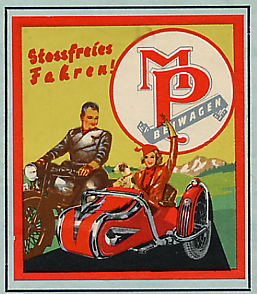
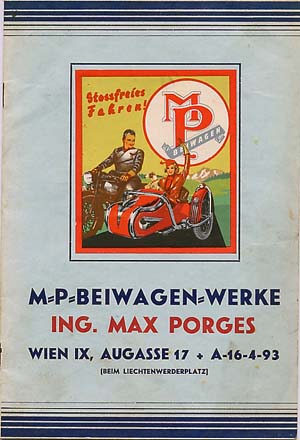
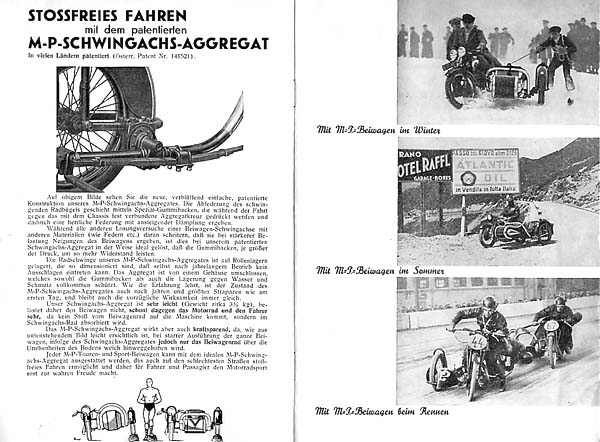
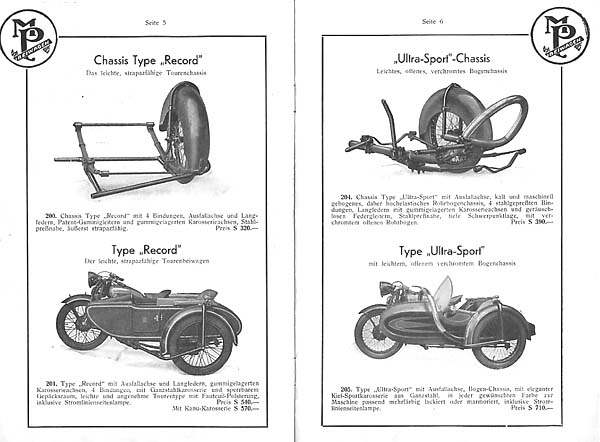
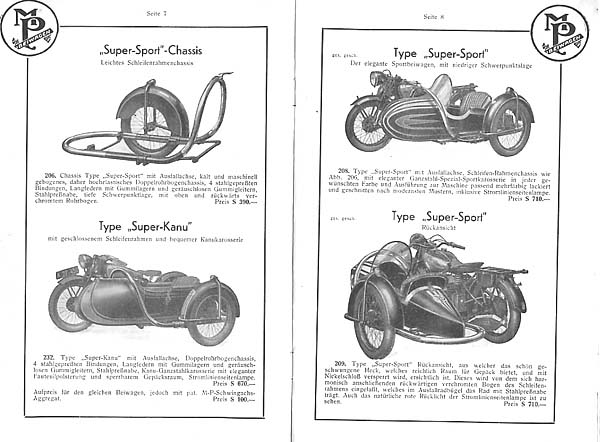
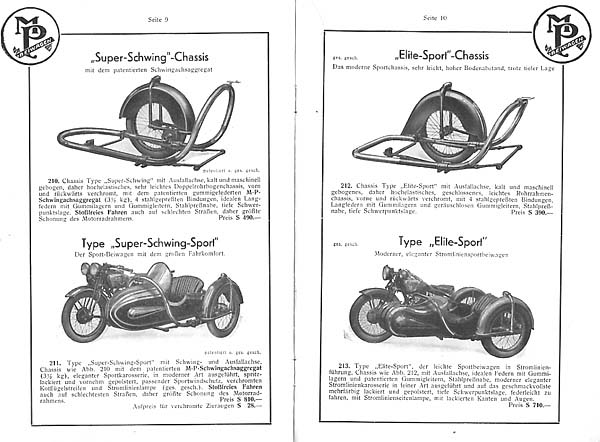
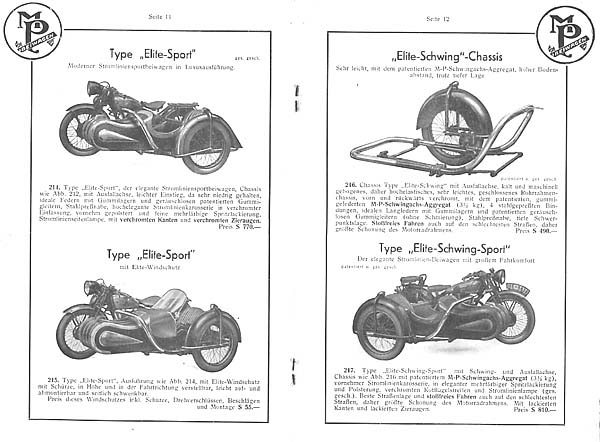
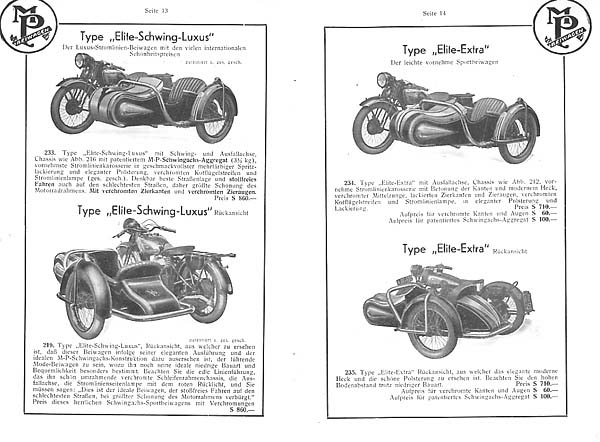
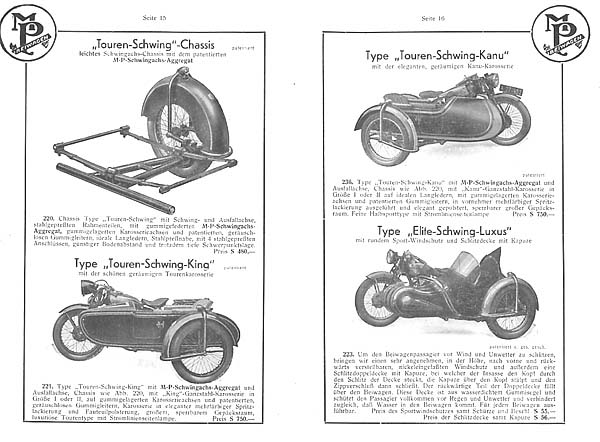
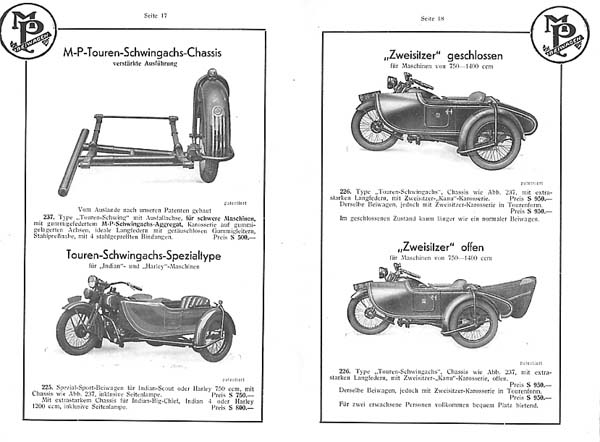
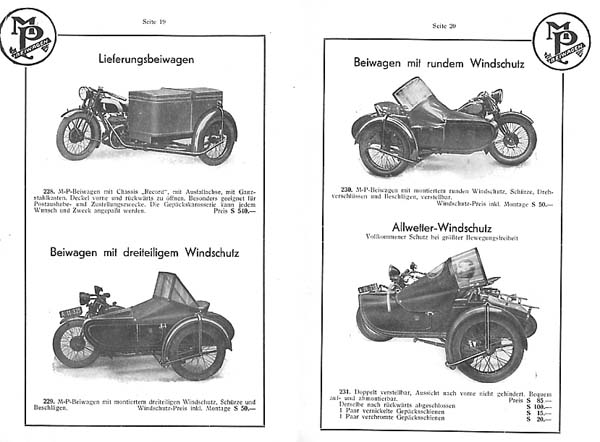
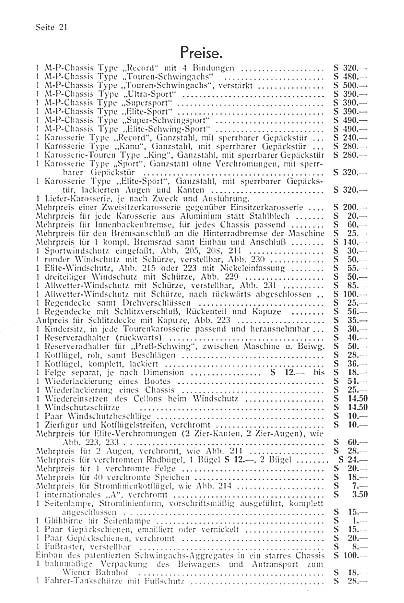
in 1920 of MP Beiwagenwerke and created motocycle side cars
(see below)
and emigrated to
Buenos aires Argentina in 1939.
Lily Porges (b. Vienna
30/06/1913, d. 12/11/2005) married 28/04/1935
Robert Eisler (b. Vienna 17/03/1907, d. 1996), emigrated
to Buenos Aires Argentina via Triest in 1938 and moved
to Lima Peru in 1993.
Haydee Eisler (b. Buenos Aires 29/12/1942) married Walter
Krieger.
She lives (2004) in Germany and has no children.
Elisa Eisler (b. Buenos Aires
19/12/1949) married Ronald Braun.
They live
in Lima (Peru). The
Braun family website.
Cynthia Braun Eisler (b. Lima Peru 03/03/1971)
married
Eddie Fleischman
2 children (Joanne (b. 05/09/1997)
and Kevin (b. 19/12/2000).
They live in Lima Peru.
Martin Braun Eisler (b. Lima Peru 06/12/1972)
lives in
Lima Peru where he is an engineer.
Gertrude Porges (b. Vienna 17/08/1922)
married 24/01/1942
Herbert (Heriberto) Joseph (b. Germany 08/01/1919)
emigrated to Buenos
Aires Argentina in 1939
Gerardo Joseph (b. Buenos Aires 16/01/1945) married Silvia
Marta Mayansky.
2 children : Andrea Mariana and Leandro Manuel.
Joseph Porges (b. 05/04/1864, d. 12/04/1932) Ludmilla Porges (b.?, d.?) married Emanuel Porges (son of Adam
Porges and Sally Pollak)
Rosa Porges (b. 11/03/1887) Josef Porges (b. 03/08/1888) Fritz Porges (b. 1892)
The Institut für Geschiste des
Juden in Österreich in St Pölten provided the following information in 2000 :
From the registration books of the Jewish community of St Pölten :
Emmanuel Porges had three children :
Rosa (b. 1887), Fritz (b. 1892), Josef (b. 1888)
Max Porges died in St P. in 1876.
Sources : Paul
Peter Porges, American cartoonist, artist and writer, and his brother
Kurt, 1993 & 2000 Elisa Braun, 2004
2009 commemoration. In 2009, within the Jewish Welcome Service Vienna project « Wien – Scheibbs – Wieselburg », members of the Porges family from the USA and Peru were invited to Vienna, and a commemorative plaque was unveiled in Scheibbs on 20 May 2009 on the building that until 1938 housed the "Kaufhaus Porges". Its bay room (Erkerzimmer) had served as the prayer room of the Jewish community of Scheibbs and its surroundings.
Who
lived at Rotensterngasse 6, 8 & 9 in Vienna 2?
The following people were deported
from Vienna and lived in the same street in adjacent houses.
Most were born in Scheibbs and Melk and belonged to the family of
Alois Porges.
Name
Birth
Address
Deportation
Death
The
person is also mentioned in the site at the following page
:
Expelled
from Vienna to a new life in the USA :"Lucie & Paul
Peter Porges - Style and Humor"
June
- November 2000 Jewish
Museum, Vienna
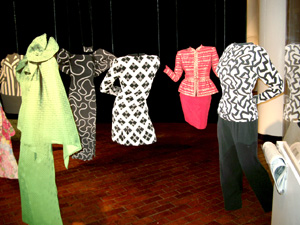
Lucie Eisenstab and Paul Peter
Porges met in 1945 in Geneva. Both had fled to France from Vienna
in 1938, Lucie with her parents, and Paul Peter through evacuation
to the children's camp at La Guette. From there he managed to reach
Switzerland on his own. After the War, Lucie, who had studied fashion
design, went to Paris where she immersed herself in the world of
haute couture, while PPP, as Paul Peter Porges called himself, followed
his parents to New York. After touring the country with a circus
for several months, he was drafted into the US Army, where he published
his first drawings and cartoons in military magazines.
On his return to New York
his career took off : the Saturday Evening Post published his cartoons,
and he also worked extensively for the cult comic Mad Magazine and
the more serious magazine The New Yorker. His cartoons showed New
York and the madness of daily life there. Lucie Porges, who arrived
in New York in 1951 and married Paul Peter there, was artist in
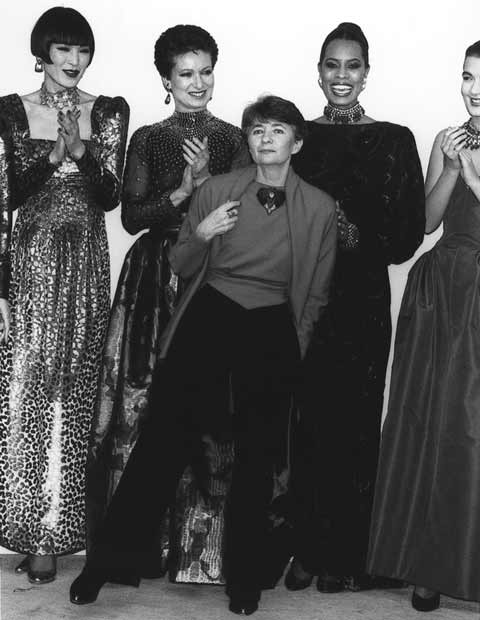
residence at Pauline Trigère's fashion house. She worked
as a designer and, together with Pauline Trigère, helped
define the company's fashions from the 1960s until the 1990s: a
Viennese designing French fashions in New York.
Lucie and PPP have been married
for 49 years. They have two daughters, several grandchildren and
an apartment on 72nd Street in New York's Upper West Side. "Lucie
& Paul Peter Porges - Style and Humor" can be seen from 31 May
until 17 September 2000 at the Jewish Museum Vienna (A-1010 Vienna,
Dorotheergasse 11).
Details on the Museum can
be found on the Internet at www.jmw.at.
The motorcycle
shop of Adolf Porges
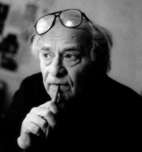
Paul
Peter Porges (aka PPP) ca 2000
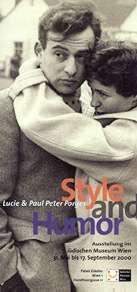
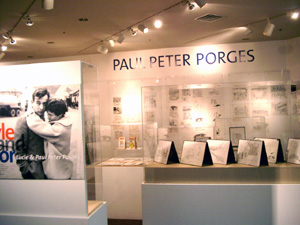
Catalog of the
Style and Humor Exhibition
Jewish Museum of Vienna (2000)
Hebrew Union College NYC (2002)
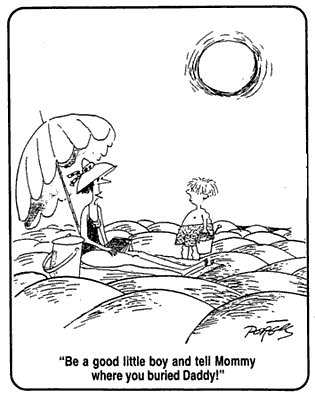
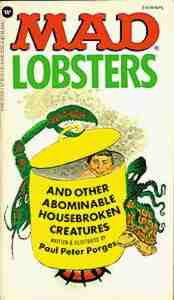
MAD Lobsters
by Paul Peter Porges
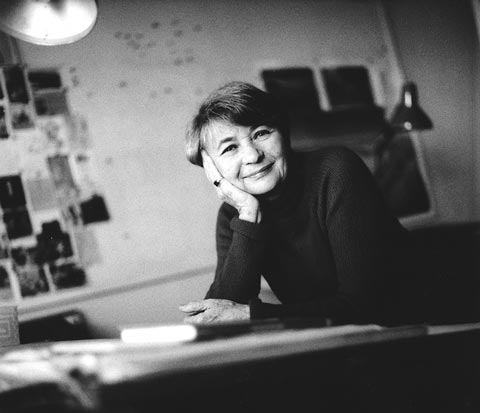
Lucie
Porges
Lucie, died June, 17th. 2011.
Our incredible, vibrant, curious courageous Lucie.
She was a fashion designer, artist, teacher, wife of 60 years to cartoonist Paul
Peter Porges,
sister to Elfi, mother of Claudia and Vivette, mother-in-law to
Jean Philippe and Paul,
grandmother of Kitt, Evan, Katalina, Ella, and Max.
We are so proud of her remarkable life, born in Vienna, Austria in 1926,
forced
by war to leave her homeland, met her future husband in Geneva 1945.
They created a new life in New York, where she designed beautiful clothes with
Pauline Trigere for 43 years.
After her retirement she went on to teach the popular class "Fashion Atelier" at
Parsons for 14 years
and continued designing on her own while loving her life,
family, friends, and traveling.
On
May 30, 2000, Lucie Porges, together with her husband, Paul
Peter,
received a noteworthy award of distinction from the
Municipal Cultural Committee of Vienna.
The same evening,
the Jewish Museum in Vienna launched an exhibition
entitled “Style
and Humor: Lucie and Paul Peter Porges.”
It was an
important and joyous event in the life of the Vienna-born
fashion designer from New York.
But the prelude to the exhibition
was complex and less joyous.
Only three months before its
opening date, the Conservative Party had established a coalition
with Jörg Haider’s Freedom Party (FPOE).
Later,
in an interview in the New York Times, Lucie Porges said
she had actually reached a decision to decline the invitation
to the exhibition.
“At first I thought I can’t
go back and be honored by the city that chased me out and
killed my grandparents.
But then I thought about all the
young friends we have made here, none of whom want Haider.
And I thought: Why let him ruin it for the rest of us? I
feel this show is rounding out the circle.
A way of showing
we have won.”
The circle rounded out by the exhibition began in 1926 in the
Viennese suburb of Favoriten, where Lucie Eisenstab was born
on November 23.
Her mother Jetty née Rosner (Dorna Watra
[Vatra Dornei, Romania], 1898–New York, 1990) who came
from Bukovina, was the daughter of a wood-merchant and had
five brothers.
During World War I, the family emigrated to
Vienna, where Lucie’s uncles established small businesses.
Lucie’s father, Eisig Eisenstab (Drogobych, 1886–Zürich,
1962) came from Galicia.
Until 1935 he was engaged in the Viennese
textile trade.
“My father’s parents were very religious.
My granddad was always going to the synagogue and my grandma
wore a shaytl (wig).
We used to go there on Sundays and I was
always bored stiff.
It was there that I started drawing fashion
pictures.
Women with small dogs, viewed from the front, the
feet turned sideways, like the Egyptians.
I knew nothing of
perspective but I was already drawing clothes.
My grandparents
had nice paper, usually invitation cards that they gave me
so that I could play and pass the time. The paper gave me inspiration.”
In 1938, Lucie, together with her parents and her sister Elfi,
who was four years her junior, were driven out of their home
in Vienna–Favoriten.
Her father was arrested following
Kristallnacht.
When he was released a few weeks later, the
family fled, without visas, via Cologne to Brussels.
Later
stations on their flight were the south of France, the internment
camp at Brens, and Lyon.
At the end of 1942 the Eisenstabs
succeeded in escaping to Switzerland.
With the end of the war
in 1945 Lucie entered the École des Beaux Arts in Geneva,
where she devoted herself primarily to drawing.
Here she also
met her future husband, Paul Peter Porges, who emigrated to
the U.S. in 1947.
In 1948, Lucie moved to Paris, where she worked for a number
of Parisian couturiers, including Maggy Rouff, and learnt the
basic skills of haute couture.
At the same time, she was drawing
for the magazine L’Art et La Mode and there established
contact with all the major fashion houses in Paris.
In 1951
she left the city of her dreams for New York, since her fiancé Paul
Peter Porges had been drafted into the U.S. army for the war
in Korea and could therefore no longer travel to Europe.
“America
came as a shock to me. New York was a sea of buildings. Everything
was cold, huge, hideous and loud.”
Lucie and Paul Peter married in June 1951 in New York City
and Lucie introduced herself to Pauline Trigère, “the
New York fashion queen with a French touch,” from whom
she received her first commission as a designer.
“Trigère
was a real maison de couture.
Practically every year we traveled
to Europe to buy fabric in Paris.
I did the sketches, but I
also organized shows, booked models, chose photographers.”
In 1956, Lucie gave birth to her oldest daughter, Claudia.
Before the birth of her second daughter Vivette in 1959, she
and her husband visited Vienna for the first time since they
had been forced to leave.
Lucie continued to work after the
birth of her daughter, developing an equal partnership with
Pauline Trigère.
While Lucie, in the role of artist
in residence and fashion designer, put initial ideas on paper,
Pauline preferred to work directly with material on a model.
Lucie Porges and Pauline Trigère also complemented each
other in their concepts of fashion: Trigère specialized
in sumptuously luxurious evening dresses, while Lucie went
in for everyday wear of relaxed elegance.
At the beginning of the 1980s, as a result of several of her
exciting designs, the New York fashion scene “discovered” Lucie
Porges independently of her partnership in the Trigère
house of fashion.
In 1982 the New York Times prominently featured
an orange coat she had designed in its Fashion supplement,
terming it “The Dashing Coat.”
In 1994 the aging Pauline Trigère closed her fashion
house.
Lucie Porges continued to design, while also imparting
her immense knowledge in the Fashion Department of the New
School for Social Research.
In 1998, Lucie and Paul Peter, who had a long career as a cartoonist
for the New Yorker, began collaborating on a joint exhibition
at the Jewish Museum in Vienna, entitled “Style and Humor.”
Despite
Jörg Haider’s election success, the artists went
to Vienna and were lauded by the Viennese press.
A year later,
the exhibition transferred to New York.
Here political events
once again impacted on the opening celebration, which was to
have taken place on September 11, 2001 at the Hebrew Union
College.
In fact, it took place on November 23.
Style
and Humor An exhibition
about Lucie and Paul Peter Porges Hebrew Union College - Museum - Brookdale
Center, One West 4th Street, New York, NY
10012 September 13, 2001 - June 28, 2002
In
1938, two 12-year-old Jewish children's
lives were changed forever : Lucie Eisenstab
fled with her parents and sister from
Vienna through Belgium and France ;
Paul Peter Porges was evacuated from
Vienna with other children to the La
Guette refugee camp in France, and made
his own way across France.
Both reached safety in Switzerland,
where they first met at the Academy
of Art in Geneva in 1945, and later
settled in New York, where they married
in 1951.
They
embarked on extraordinary careers :
Lucie as the artist-in-residence and
principal fashion designer at Pauline
Trigere for four decades;
PPP as the popular cartoonist whose
work appeared regularly in The New Yorker,
Mad Magazine, and The Saturday Evening
Post.
From the high style
of fashion to the irreverent humor of
cartooning, their lives and careers affirm
the essence of Jewish creativity and vitality.
Their unique accomplishments challenge
us to ponder the infinite potential of
the 1.5 million Jewish children of the
Porges's generation who did not survive
the Holocaust.
Kurt Porges
Geboren 1920 in Wien / 1939 Flucht
in die USA
sein Dienst in der US-Army ermöglichte ihm 1945
seine Familie in die USA zu holen
arbeitete für eine New Yorker Tageszeitung
Family
of Max Porges
1- Lily Porges 15 years old
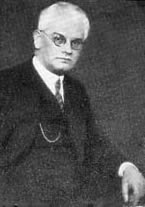
2- Ing Max Porges
3- Lily and Gerty(Gertrude)Porges
4- Max, Berta, Lily, Gerty on a summer holiday in Europe
5- Berta Gottlieb Porges and Max Porges in Buenos Aires,Argentina
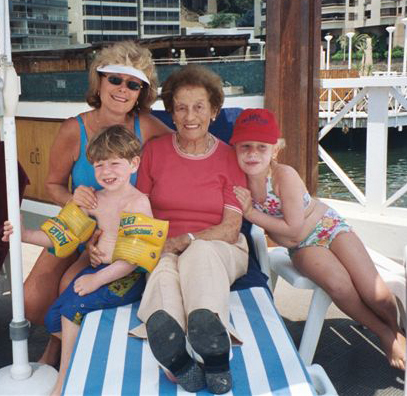
Lily Porges Eisler, her daughter
Elisa and her grandchildren (2004)
Vienna
Phone books (1932/1938) : Porges, Ing. Max
Wohnung : VII., Zieglerg. 3 (B 37 1 11)
M.P., Beiwagen-werke, IX/1., Aug. 17 (A
16 4 93)
Possibly related
:
Porges, Alice
VII., Zieglerg. 57. (B 34 9 71)
The
Theresienstadt list mentions the following : Porges, Alice (b. 15.12.1870)
Transport to Terezin Au-405, died
— English translation —
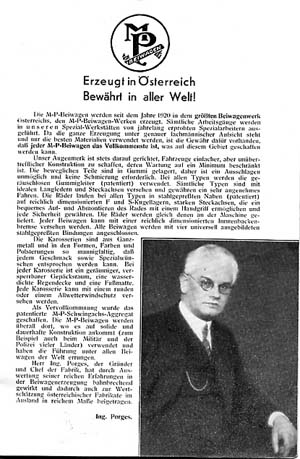
Made in Austria
Proven worldwide!
M-P sidecars have been manufactured since 1920 at Austria's largest sidecar factory, the M-P-Beiwagen-Werke. All operations are carried out in our specialized workshops by skilled workers with many years of experience. Because the entire production is under strict expert supervision and only the finest materials are used, there is every assurance that each M-P sidecar is the most perfect product that can be created in this field.
Our focus is always on creating vehicles of simple yet unsurpassable design, with maintenance kept to a minimum. The moving parts are mounted in rubber, so wear is impossible and no lubrication is required. All models use the silent rubber sliders (patented). All models are equipped with ideal long springs and quick-release axles, providing a very comfortable ride. On every model, the wheels run in steel-pressed hubs (patented) on generously sized F and 5 ball bearings, with strong quick-release axles that allow the wheel to be mounted and removed conveniently with a single hand movement and provide complete safety. The wheels are supplied to match those of the motorcycle. Each sidecar can be fitted with a generously sized internal shoe brake. All sidecars are attached by four universally designed steel-pressed couplings.
The bodies are all-metal and so varied in shapes, colors and upholstery that every taste as well as special requests can be accommodated. Each body has a spacious, lockable luggage compartment, a waterproof rain cover and a floor mat. Each body can be fitted with either a round or an all-weather windshield.
As a further refinement, the patented M-P swing-axle assembly was developed. M-P sidecars are used wherever solid and durable construction matters (for example, by the military and police forces of many countries) and have achieved the leading position among all sidecars in the world.
Mr. Ing. Porges, the founder and head of the factory, has done pioneering work by drawing on his extensive experience in sidecar manufacturing, thereby contributing substantially to the appreciation of Austrian products abroad.
(Translated from German)
 Lazar (Alois Porges) (b. 1813, d. 16/06/1898 (Friedhof Ybbs))
 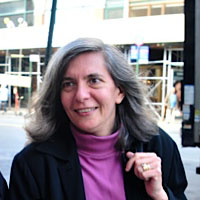 Vivette Catherine Porges (b. NYC 24/03/1959) married Paul
Shorr. Lives in
NYC
Vivette Catherine Porges (b. NYC 24/03/1959) married Paul
Shorr. Lives in
NYC